- The date that can't move: Dictates whether stock can be drawn from existing bench runs or requires a dedicated pre-grow program to meet project milestones.
- The pot sizes on the schedule: hese directly determine the lead time reality. Smaller container stock (300mm to 450mm) can often be turned around in 8 to 12 weeks from bench stock, or 6 to 9 months grown to order. Advanced specimen trees (200L and above) require 12 to 18 months or more of contract growing.
- Who holds the stock if the site isn't ready: Addresses the common risk of construction delays by establishing clear extension and holding terms upfront before trucks leave the nursery.
Depending on container sizes, lead times range from 8 to 12 weeks for smaller bench stock up to 12 to 18 months or more for 200L and above specimen trees grown under contract. To ensure quality and compliance across every project stage, Florafolia grows tree stock to AS 2303:2018 standards under audited NIASA accreditation held since 1997.
18 months out: your fixed completion date dictates what is realistic
Every commercial build has one non-negotiable deadline; whether that is grand opening day, practical completion, or a defects handover.Working backward from that fixed date determines your entire soft landscaping schedule:
- It sets pot size limits: It decides whether there is enough lead time to grow advanced trees under contract or if the project must rely on smaller, ready-to-go container stock.
- It filters the species list: It narrows selection to plants tough enough for immediate site realities, like foot traffic, reflected heat off concrete, and erratic initial watering.
- It protects against trade delays: Soft landscaping is usually the final phase of a build, meaning planting windows often get squeezed when earlier construction trades run late.
At tender: what we need to price a schedule
- The plant list, in draft is fine
- The landscape vision is useful; it helps us make suggestions if a listed plant is not available
- The program, including whether the planting date is fixed or floats with the trades ahead of it
- Whether delivery is staged or lands in one drop
- What's complete before stock goes in: irrigation, drainage, soil profile,
- Any compliance requirements
- Site access constraints
If the program slips after stock is ready, extensions cover the gap, and weekly rates are worth having in the quote rather than negotiating at the point it happens. Our guide to plant supply sets out those terms in full.
Of everything on that list, pot size is the item that most often changes our answer.
At tender: pot size decides the lead time, not the price
A 200 litre tree carries years of production behind it. When a schedule calls for forty at that grade, the question we're answering is whether the crop went in three years ago.On a quote, the step from 100 litre to 200 litre reads as a price difference. On our production calendar it's a lead time difference, and it's the most common reason we come back with a substitution rather than a yes. Past a certain point in the program, the larger grade doesn't exist at any price.
- 300mm to 450mm: 8 to 12 weeks, bench stock or short pre grow
- 100L to 200L: 6 to 12 months, staged pre-grow program.
- 200L and above, specimen trees: 12 to 18 months, full contract growing to AS2303
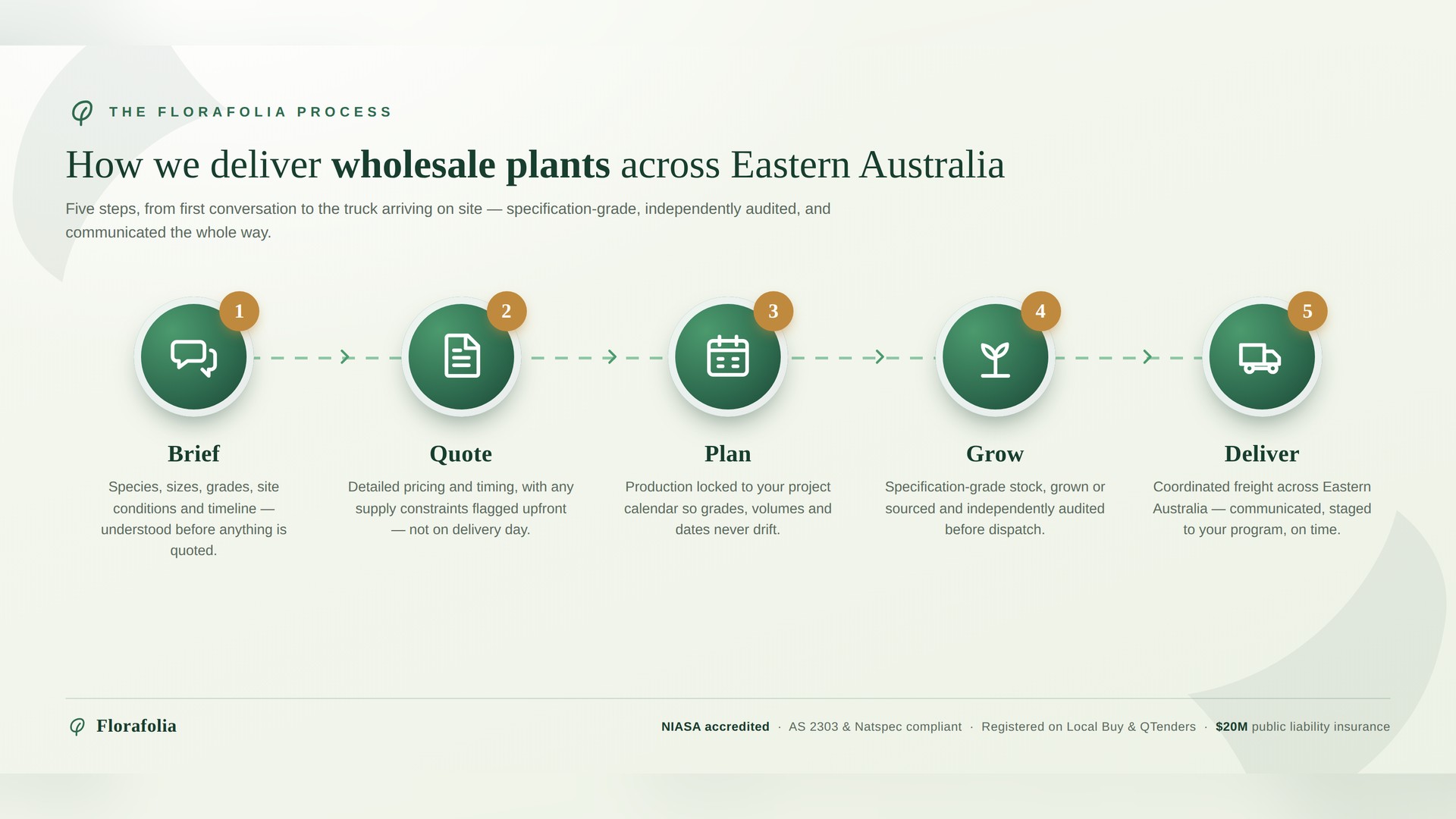
For how the ordering process runs step by step, see our five-step process.
If the crop exists, the next question is whether all forty of them will match.
Through the grow: what AS 2303:2018 checks before stock leaves
Forty trees from one crop look like forty trees. Forty trees assembled from four suppliers in a hurry look like four groups of ten. On a shopping centre entry or a civic forecourt, that's visible from the car park.
AS 2303:2018 is what civic tree tenders are written against and what we grow to. Size Index, so calliper and height sit inside the preferred range rather than arriving under grown. Root quality, so root balls are free of girdling, kinking and J-roots, and wider than they are deep. True-to-type, so what arrives matches the botanical name on the schedule.
NIASA accredited since 1997, audited annually. If stock doesn't meet spec, it doesn't leave.That standard covers tree stock. Interior planting is judged on entirely different terms.
Through the grow: exterior trees and interior foliage on one schedule
Advanced tree growers don't usually hold interior foliage. Indoor foliage specialists don't grow specimen trees. A project needing both ends up running two schedules, two lead times, two grading standards and two delivery programs.
We grow both, on one site, to the same standards, on one order.
Interior and undercover positions behave differently to exterior ones: low light, air conditioning, no rainfall, foot traffic at close range with no soil buffer. Species that perform outdoors in the same climate will often fail indoors inside a season, so we select against the position rather than the region.
Delivery week: the site sets the window, not the nursery
We can load up semi-trailers at the nursery, but that doesn't help if your site has narrow driveways, tight corners, or no room for a large truck to turn around. We need to know what the access is for the receiving site, if there is a crane, forklift, or telehandler on site to unload them, or where they can be temporarily stored if they aren't going straight into the ground.
Deliveries may need to run before opening or after close, and stock may need to move through public doors. We build the delivery schedule around that and price it at quote stage.
After handover: who carries the plants through establishment
Most supply conversations cover species, sizes, grades and delivery windows. Almost none of them cover day two. If you are procuring plants from a supplier, then ensure that you know what is going to happen to your plants when they arrive at the project location. That conversation is easier to have before the truck is loaded than after.
Under our supply terms, risk passes on dispatch. That is standard across the industry, and we say it at quote stage rather than after the fact.
We will always be straight about where our end of the job finishes. We are responsible for supply. Plants that leave here on spec, on time, graded and true to type. What happens on site after that is a different job and a different skill set, and it is not ours. We say so up front rather than letting it be discovered later, because the alternative is a conversation nobody enjoys.
Between installation and the day a maintenance contract starts, responsibility for the plants can sit with nobody in particular, and that gap usually falls across the trees' most vulnerable season. Five things worth nailing down at quote stage:
- Watering regime through establishment, and who is executing it
- Staking, and when it comes off
- Mulch depth and type
- Inspection frequency
- What triggers a replacement claim during defects, and who carries it
A tree that arrives in great condition and dies in month seven is an establishment question, not a supply one. Far cleaner to settle that on the quote than to work it out in month eight.
Stock that arrives off spec is a separate matter. Report it within 48 hours and we replace it or credit it.
Four considerations
Four issues account for most of what we raise when a schedule comes in. All four are a short conversation at tender. All four are expensive once the trucks are booked.Microclimate, not postcode
A species that performs outdoors in the same suburb can fail in an entry foyer inside a season. Air conditioning drafts, reflected heat off glass and paving, and permanent low light all change what holds. We raise it when a schedule puts an exterior specimen into an interior position. Settle at tender.
Access confirmed before the truck is loaded
200 litre stock needs a crane or telehandler and somewhere to stand once it's off the tray. A delivery bay that won't take the truck or the machine is a problem discovered at 6am on the morning of the drop. We ask about access width, turning circle and staging area when we quote. Settle at tender.
Stock-holding agreed in the quote
Civil work can run late. When stock is ready and the site isn't, holding has to happen somewhere and someone pays for it. In the quote it's a line item with a weekly rate.
Establishment responsibility named in writing.
Between install and a maintenance contract starting, the trees go through their most vulnerable season with nobody clearly accountable. We will ask you to name who waters, who inspects and who carries a replacement during defects.
One project, all five stages: Alstonville Aged Care Facilities
Where to start
If the schedule includes advanced stock, talk to us 12 to 18 months out and we'll plant the crop against your program.
Send us the plant list, the program and any compliance requirements. We'll come back with availability, lead times and pricing, and flag anything that needs a substitution before you commit. Talk to us about your project.
FAQ
What are the lead times for advanced trees on a commercial project?
It depends on whether the stock already exists. From bench stock or a short pre-grow, 300mm to 450mm container stock runs 8 to 12 weeks. Grown to order for a project, allow 6 to 9 months for that same size range, 6 to 12 months for 100L to 200L on a staged pre grow, and 12 to 18 months or more for 200L and above under full contract growing to AS 2303:2018.
How far ahead does Florafolia need a schedule for contract-grown stock?
12 to 18 months for a full pre grow program. A draft schedule is enough to start planning production against, and the crop is then reserved to the project rather than sold into the open market.
Can one supplier handle both exterior and interior planting on a commercial project?
Yes. Florafolia grows advanced trees and subtropical foliage on the same site at Rous, NSW, so mixed schedules covering exterior beds and interior or undercover planters run as one order, one grading standard, one point of contact.
How is stock confirmed to meet Size Index before dispatch?
Calliper and height are checked against the preferred range under AS 2303:2018, with grading before dispatch. Advanced specimens and screening rows can be hand-tagged or inspected on site. Florafolia has been NIASA accredited since 1997 and is audited annually.
Who carries responsibility for plants after installation?
Stock that arrives off-spec is reported within 48 hours of delivery and replaced or credited. Establishment after installation is the purchasers responsibility.
What happens if a specified species isn't achievable at the required grade?
Florafolia flags it in the quote with an alternative that performs in the same position, before anything is committed. Substitutions aren't made without approval.